This episode is brought to you by Your Clockwise Week—a personalized weekly structure built around your actual life, not an ideal one. If your week feels full but not fitting, you can learn more at mikevardy.com/yourclockwiseweek. There's an assumption buried inside almost every productivity system, self-help framework, and optimization routine: that you're not enough yet. That the gap between who you are and who you should be is the central problem to solve. I've spent fifteen years in this space, and I've watched that assumption quietly do a lot of damage. My guest today has spent roughly the same amount of time making the case that sometimes the belief that you need to improve is a bigger problem than whatever you're trying to fix.
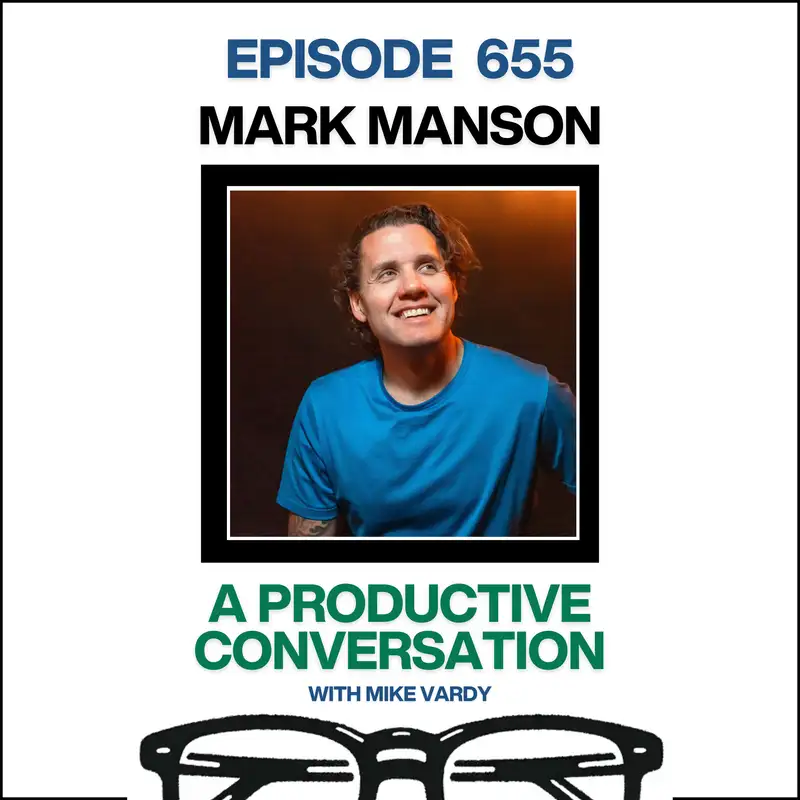
Mark Manson is the author of
The Subtle Art of Not Giving a F*ck and
Everything Is F*cked: A Book About Hope, two of the most widely read books in the personal development space over the last decade. He's the host of the
Solved podcast, where he and his research team do exhaustive, long-form deep dives on the ideas most podcasters treat like talking points. And he recently co-founded Purpose, an AI-powered platform designed to make personal growth coaching accessible at scale. Mark and I have a lot of shared territory in this conversation—and a few places where we push each other in productive directions.
Six Discussion Points - The backwards law in action: why every message of "you need to improve" carries an implicit second message—that you're not enough as you are right now
- Why optimal is suboptimal—and how relentless optimization can make the quality of your actual life measurably worse, not better
- The two dimensions of productivity most advice ignores: hours worked is not the same as leverage, and until you separate them, no system will help you
- Why effort is a double-edged sword—it only creates meaningful output when it's aligned with something that actually matters to you, and it actively works against you when it isn't
- How language shapes whether an idea lands—why the same truth needs to be said differently at different moments in a person's life, and why that's not semantics, it's everything
- The question Mark poses before chasing any goal: do you actually want the costs? Not the highlights—the daily friction, the ongoing compromise, the downside of the dream
Three Connection Points
Mark's most useful provocation in this conversation isn't the one with the sharpest edge. It's the quieter one: before you add another goal, another system, another layer of self-improvement, ask yourself whether you actually want to live with what it costs. Not the version of it that works. The version on the hard days. The answer to that question tells you more about whether you're chasing the right thing than any productivity metric ever will.
If this episode resonated, I’m exploring ideas like these more deeply in my upcoming book, Productiveness. You can follow along as it takes shape at mikevardy.com/productiveness.
 Episode 655